Routines are so important in children's lives to help establish expectations, develop better behavior and a sense of personal control.
According to the Center on the Social and Emotional Foundations for Early Learning,
Studies have documented that schedules and routines influence children's emotional, cognitive, and social development. Predictable and consistent schedules in preschool classrooms help children feel secure and comfortable. Also, schedules and routines help children understand the expectations of the environment and reduce the frequency of behavior problems, such as tantrums and acts of aggression.
For kids with special needs, a daily routine allows them to know what to expect and how to prepare for it. If a child doesn't know what to expect they are in a constant state of worry or heightened anxiety for what's to come next. And if "what's next" is something they feel they can't handle, negative behaviors tend to come forward including meltdowns, and tantrums.
Depending on the child routines for morning, meal times and bedtime are important to establish many aspects of healthy living, good habits and good behavior. Visual picture schedules work great for day to day activities. Large calendars with pictures of doctor appointments, 1st day of school, soccer practice or dentist visits are a way for children to get prepared for what's to come.
If you have any experience or insight on the importance of routines, please share!
Wednesday, August 17, 2011

Facebook!!
Don't forget to check out our Facebook page for additional ideas, tips, articles, and happenings at CTC!
http://www.facebook.com/pages/Childrens-Therapy-Center/159943524060224
http://www.facebook.com/pages/Childrens-Therapy-Center/159943524060224
Tuesday, August 16, 2011
The Brushing Program

The Wilbarger Brushing Program has been around for over a decade. More and more people have heard about this sensory treatment and seen its results firsthand. We prescribe this home/school program either as a tool for calming, or most commonly, to decrease tactile (touch) defensiveness (extreme hypersensitivity). As therapists, we teach families and other caregivers the protocol by demonstration, use of handouts, and close monitoring. This is to ensure optimal outcomes by making sure technique is correct and that high frequence of every one and a half - two hours it is performed for a minimum of two weeks. The families that see the benefits are the ones that follow through with this high frequency thus creating further motivation to continue the program. Unfortunately the benefits are not seen when the follow-through is not consistent. Families that are not able to achieve this high frequency do not see results are not commited to continue with the program. Depending on when your therapist went to training, you might see some variation in the actual "speed" of the brushing, but one thing they should be telling you is that the deep pressure you use to the specified areas is most important. We want to get those deep receptors in the skin, not the light touch receptors that trigger a negative "fright, flight, or fight" response. We use a surgical soft plastic brush and cover the surface area of the skin of the arms, hands, legs, feet, and back. Then we follow up with some proprioception (input to the muscles and joints). The whole thing is like a massage. If your child has oral sensory defensiveness, we may try an oral brushing protocol, along with the body. The whole protocol should only take a few minutes to complete. The positive outcomes we see are many. Included may be the following: less irritable, improved focus and attention, improved tolerance to complete hygiene tasks and wearing a variety of clothing, less rigid behaviors, improved calming, better sleep and improved eating, just to name a few. Ask your therapist if the program could help you and your child.
Thursday, July 14, 2011
Interactive Metronome
Interactive Metronome (IM) is an assessment and treatment tool used to help children with their neurological processes of motor planning, sequencing, and processing. The program provides a structured, goal-oriented process that challenges kids to synchronize a range of hand and foot exerices through a computer program. There is a reference tone provided via headphones and children attempt to match that tone with repetitive actions, including clapping their hands, tapping their feet, and a combinaton of the two. Feedback regarding their performance is provided via auditory and visual cues through the headphones and computer screen. The program is designed to be used for children at the development age of 6 years old and above.
Through this intervention approach, children have been noted to improve:
http://www.interactivemetronome.com/
Through this intervention approach, children have been noted to improve:
- motor skills
- attention and concentration
- cognitive speed
- executive functions
- language processing
- memory
- motor control and coordination
- phonological awareness
- reading and math fluency
- self-control of aggression/impulsivity
- sensory processing
- stuttering
http://www.interactivemetronome.com/
Tuesday, July 5, 2011
Sensory Sand Play!
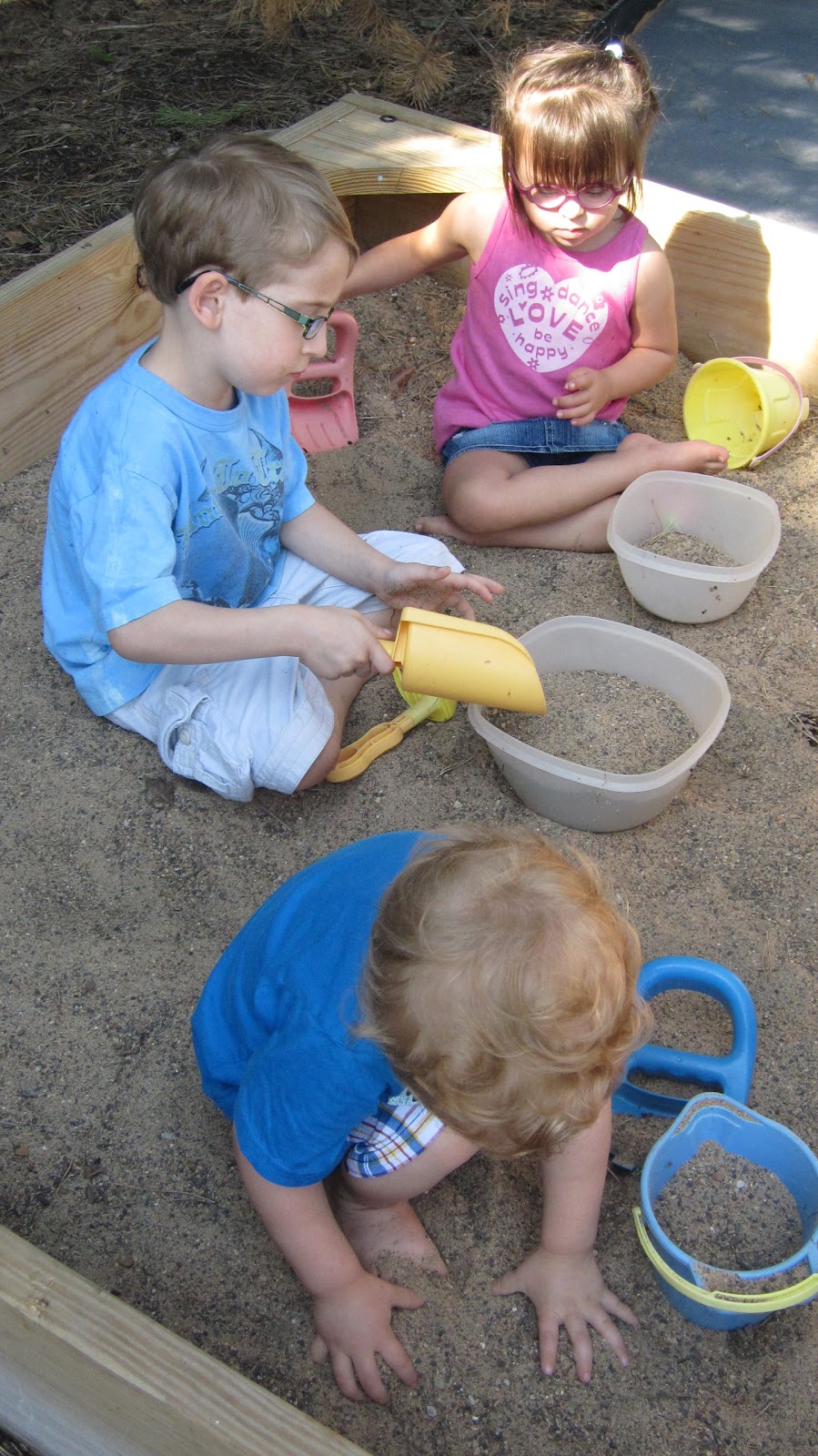
Sand play is a great sensory play experience for your kids!
It's a great textured play activity for your kid's hands, feet, lets, and arms. Sand play also allows for great peer play opportunties to work together to build sand castles or dig and fill buckets. Play with both wet and dry sand for an expanded sensory experience.
To clean up after playing, use a hose, water guns, spray bottles, water balloons, or sprinklers for a sensory water play experience!
Let us know how it goes!
![]()
It's a great textured play activity for your kid's hands, feet, lets, and arms. Sand play also allows for great peer play opportunties to work together to build sand castles or dig and fill buckets. Play with both wet and dry sand for an expanded sensory experience.
To clean up after playing, use a hose, water guns, spray bottles, water balloons, or sprinklers for a sensory water play experience!
Let us know how it goes!
Tuesday, June 21, 2011
Activities for Kids!
This website lists a number of websites for different organizations, events, and locations that offer opportunities for children with special needs. Check it out and let us know what you think! If you know of similar websites or organizations we should know about, please share!
http://webpages.charter.net/rientsfamily/index.html
http://webpages.charter.net/rientsfamily/index.html
Thursday, June 2, 2011
The Listening Program Stimulus Package!
The Listening program is a home program designed to help with auditory sensitivity, auditory processing, attention, behavior and many areas that impact home, school and work. It's a 10-20 week program that includes listening to psychoacoustically modified classical music for 30 minutes per day. To learn more check out the website AdvancedBrain.com
Regular Price: $475 Currently on sale: $295 which includes headphones.
Ask your therpist about it! Sale lasts through June!
Ask your therpist about it! Sale lasts through June!
Subscribe to:
Posts (Atom)