Showing posts with label Sensory. Show all posts

Thursday, March 20, 2014

Interactive Metronome


One program that we offer here at CTC is called Interactive Metronome (IM). This is a therapeutic assessment and training program that has been shown to help with many areas including attention, coordination and motor planning, language processing and control of impulsivity and aggression. Many individuals both children and adults can benefit from interactive metronome.

IM is a structured program that continues to challenge the client to synchronize various body exercises to a beat that is generated on the computer system. The client will try to match the beat with repetitive movements such as clapping hands together, using both feet to step on a foot pad, etc. IM incorporates both auditory and visual stimuli to help the client match the beat.  The program increases in difficulty as the child progresses each session and as they improve in their motor planning and sequencing skills.

Here at CTC, interactive metronome is a program that is completed three times per week. Each session is one hour long. The program is 12-15 sessions long. Interactive metronome can be repeated after the first time the program is completed but it is recommended to wait about six months before doing a second time in the program.

If you would like more information, stop in at CTC and ask for a brochure on IM or check out their website at www.interactivemetronome.com!

Friday, April 12, 2013

April is Occupational Therapy Awareness Month! *Repost*

April is Occupational Therapy month! There are many people who do not know what occupational therapy is or what we do in the profession. This month is a great start to helping those around us understand how important occupational therapy is for many people of all ages! Occupational therapy’s goal is to help others in a holistic way, meaning looking at the whole picture of whom a person is, including their physical, psychological, emotional and social aspects. OT works to help others function in their everyday life and achieve their goals. Specifically, looking at how occupational therapy helps in a pediatric setting is very different from looking at what they do in other settings. In a pediatric setting, like this out-patient clinic or in the schools, occupational therapy can help kids in many ways. This includes working on cognitive skills such as memory (remembering how to make shapes and letters) and sequencing. OT helps with both gross and fine motor skills. Gross motor skills that OT works on could include both coordination and balance. Fine motor skills include hand strength, control of arms, wrists and hands and finger dexterity which helps with handwriting skills. OT also works with kids on self care skills including getting dressed, feeding and hygiene tasks such as washing hands or brushing teeth. Social skills are also a part of what OT works on with kids including playing with peers and listening/following directions. Sensory differences are something else that OT can incorporate into their sessions to help children function in everyday life. These are all different areas an OT can work on with children to help them succeed in their everyday lives! Go out and spread the word on how OT has helped your child!

Tuesday, May 1, 2012

Planting Flowers For Sensory Fun!

Planting flowers and vegetables is a great sensory play experience for your child! It encourages your child to work through the dirt by using their hands (or even their feet!), both wet and dry, to experience a variety of textures through a functional play activity. This can help these kids who are seeking out sensory play activities, as well as those who are more hesitant to get messy. By having your child participate in an activity that has an outcome they can see, this often motivates them to continue to participate in the task!

They can also work on problem solving and following multiple step directions of how to dig up the dirt, put it in the pot, add the seeds, cover up the seeds, and then water what they have planted. Have your child push or pull the planting items in a wagon or wheelbarrow to incorporate a "heavy work" activity into the task as well. This is great to keep your child's engine running "just right". After they are done with the planting, they can use a hose to clean off their hands and/or feet for an even greater sensory play experience! Have them water their plant daily and monitor the growth of their plant!


Monday, April 23, 2012

April is Autism awareness month!

April is Autism awareness month! New studies report that 1 in every 88 children are now diagnosed on the autism spectrum in the United States. Autism is characterized by difficulties in social interaction and communication. Children on the spectrum can also have difficulties with motor coordination, sensory sensitivities and can also have physical health issues including poor sleeping patterns or gastrointestinal issues.

There are lots of different and fun ways to go out into the community and be a part of autism awareness month! Get in touch with your local Autism Speaks chapter! Go to a "sensory friendly film" put on by AMC theaters and the Autism society. The movie auditorium provides a more comfortable experience for those with sensory difficulties and their families by having the lights on and the sound down. The movie theater also allows families to bring in their own casein and gluten free snacks for their children.

For more ideas go to the Autism Society webpage http://www.autism-society.org/get-involved/state-resources/minnesota.html to find more local events in your area!

Wednesday, April 11, 2012

April is occupational therapy awareness month!

April is Occupational Therapy month! There are many people who do not know what occupational therapy is or what we do in the profession. This month is a great start to helping those around us understand how important occupational therapy is for many people of all ages! Occupational therapy’s goal is to help others in a holistic way, meaning looking at the whole picture of whom a person is, including their physical, psychological, emotional and social aspects. OT works to help others function in their everyday life and achieve their goals. Specifically, looking at how occupational therapy helps in a pediatric setting is very different from looking at what they do in other settings. In a pediatric setting, like this out-patient clinic or in the schools, occupational therapy can help kids in many ways. This includes working on cognitive skills such as memory (remembering how to make shapes and letters) and sequencing. OT helps with both gross and fine motor skills. Gross motor skills that OT works on could include both coordination and balance. Fine motor skills include hand strength, control of arms, wrists and hands and finger dexterity which helps with handwriting skills. OT also works with kids on self care skills including getting dressed, feeding and hygiene tasks such as washing hands or brushing teeth. Social skills are also a part of what OT works on with kids including playing with peers and listening/following directions. Sensory differences are something else that OT can incorporate into their sessions to help children function in everyday life. These are all different areas an OT can work on with children to help them succeed in their everyday lives! Go out and spread the word on how OT has helped your child!

Tuesday, October 18, 2011

Halloweeeeen!!!

Holidays are a great time to encourage new ways of working on therapeutic activities in a fun manner! Here are some of our Halloween themed suggestions.....

Carving pumpkins offers a variety of fun ways to work on therapy goals. For those sensory kids, it's a great messy play experience to help dig out the insides with their hands or finger paint the outsides. For kids who are working on shape formation, they can help by drawing faces on the pumpkins with markers. If they don't turn out how they want them to, they can always wipe them off and start over again! For older kids who need to work on strength, have them help with some of the simple carving with safe tools and adult supervision.

To work on fine motor skills, have your children color fun Halloween themed pictures, finger paint, cut out new shapes, and fold paper to make spider legs. You can also work on fine motor by using pipe cleaners to wrap around suckers to make spiders or bugs.

For sensory kids who need calming activities, wrap them with Ace bandages and make them into mummies for a calming input. You can also have them work on heavy work by having them help by carrying or rolling pumpkins from one location to another.

For the sensory kids who need to work on interacting with more textures, you can present them with a variety of bowls of foods and have them guess what they might be - with their eyes open or closed. Peeled grapes could be eyeballs, spaghetti noodles could be worms, jello or wet sponges could be brains, plastic fork tines could be vampire teeth, and corn can be teeth.

To work on speech sounds focus on your target sounds. For example, if your child is working on the "k" sound, talk about things that are spooKy, pumpKins, icKy, blacK Cats, etc.

Have fun!!!

Thursday, September 29, 2011

New Blog to Read

http://www.momenough.com/
This is a blog recommended by one our occupational therapists here at Children's Therapy Center. It is written by a mother and daughter team sharing thoughts and ideas of their own, as well as guest bloggers, to help mothers (and fathers!) maneuver parenting.
There is a blog post - Does your child struggle to get going in the morning, slow down at night or stay focus any time of the day? - that is particularly related to some of the sensory concerns related to many of the children we see here at Children's Therapy Center that could be of use for ideas at home!
Let us know what you think!

Wednesday, September 7, 2011

Riding the Bus

Riding the bus can be unexpectedly overwhelming experience for your child, which could affect their day at school and/or their evening once they get home. Being on a bus offers a variety of sensory experiences that may compound into too much for one sensory-sensitive body to handle.

First, it's important to consider the new environment (even if your child has been on the bus in the past). There will be new children, possibly a new driver, people sitting in different seats than they are accustomed to, or a new bus in general. If possible, try to help your child find a buddy to sit with on the bus so that they have a familiar person to look to each time they ride. It can also be helpful to have the child have the option to consistently sit in the same seat. If you child is extremely sensitive to these routines, it may be helpful to work with the bus driver to make sure that seat will always be available. Otherwise, it would also be an opportunity to discuss with your child that the seat availability may change from day to day.

The sights, sounds, and/or a combination of these things can easily be overwhelming for a child. Visually, a lot children moving around throughout the bus in combination with the fast moving scenery passing by can be overwhelming, but may also make your child feel unwell. Bright sunshine in their eyes can also be overwhelming. Seating your child in the front of the bus to reduce the input of so much stimuli can be helpful, as well as considering wearing a hat or sunglasses. As many of you know, the volume level on a bus can be extremely loud! The bus drivers can help as much as possible to keep the volume level of your child's peers to a dull roar but other techniques may also be useful. You could try incorporating headphones (calming music would be the best), ear plugs, or even a thick stocking cap in the winter to block out some sound. Having the windows open on the bus also increases the volume level to include the noises from outside and also the sound of the wind. Remember, this doesn't bother all people, but it can be extremely bothersome to a sensitive child. Depending on the child, it could be better for them to sit in the back of the bus or in the front of the bus, depending on the above factors.

Some general ideas of activities or items to use on the bus to help keep your child in a calm state could include having a fidget available for your child. This could be a simple keychain attached to his or her backpack, a small piece of silly putty, a rubber band to fidget with around the wrist, or something similar. Headphones can be a great way of drowning out sounds and also gives the opportunity to incorporate music that can be calming for their bodies. Chewing gum (the thicker, the better) is a great calming tool. Having a great peer to interact with on the ride helps the time go faster and can also distract the child from some of the stimuli around him or her.

Once they get off the bus, they still may be feeling overwhelmed and could likely benefit from a "sensory break". This could include some quiet time by themselves, heavy work, complete the brushing program, swinging, listen to calming music, etc. These activities can also be helpful before getting onto the bus, as well!

Questions, other ideas, comments, concerns we can address??? Let us know!!!

Tuesday, August 16, 2011

The Brushing Program


The Wilbarger Brushing Program has been around for over a decade. More and more people have heard about this sensory treatment and seen its results firsthand. We prescribe this home/school program either as a tool for calming, or most commonly, to decrease tactile (touch) defensiveness (extreme hypersensitivity). As therapists, we teach families and other caregivers the protocol by demonstration, use of handouts, and close monitoring. This is to ensure optimal outcomes by making sure technique is correct and that high frequence of every one and a half - two hours it is performed for a minimum of two weeks. The families that see the benefits are the ones that follow through with this high frequency thus creating further motivation to continue the program. Unfortunately the benefits are not seen when the follow-through is not consistent. Families that are not able to achieve this high frequency do not see results are not commited to continue with the program. Depending on when your therapist went to training, you might see some variation in the actual "speed" of the brushing, but one thing they should be telling you is that the deep pressure you use to the specified areas is most important. We want to get those deep receptors in the skin, not the light touch receptors that trigger a negative "fright, flight, or fight" response. We use a surgical soft plastic brush and cover the surface area of the skin of the arms, hands, legs, feet, and back. Then we follow up with some proprioception (input to the muscles and joints). The whole thing is like a massage. If your child has oral sensory defensiveness, we may try an oral brushing protocol, along with the body. The whole protocol should only take a few minutes to complete. The positive outcomes we see are many. Included may be the following: less irritable, improved focus and attention, improved tolerance to complete hygiene tasks and wearing a variety of clothing, less rigid behaviors, improved calming, better sleep and improved eating, just to name a few. Ask your therapist if the program could help you and your child.

Tuesday, July 5, 2011

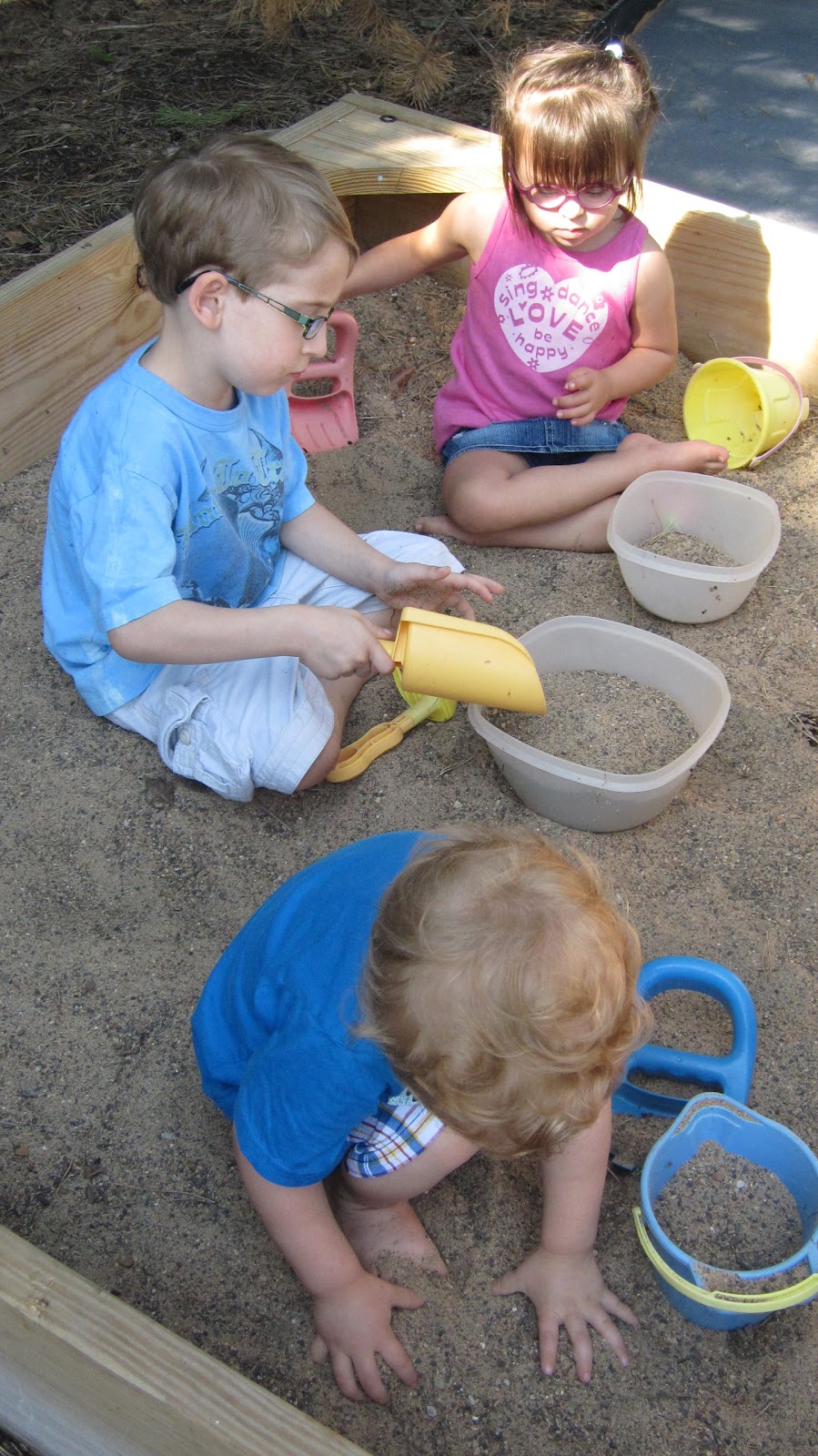
Sensory Sand Play!

Sand play is a great sensory play experience for your kids!
It's a great textured play activity for your kid's hands, feet, lets, and arms. Sand play also allows for great peer play opportunties to work together to build sand castles or dig and fill buckets. Play with both wet and dry sand for an expanded sensory experience.
To clean up after playing, use a hose, water guns, spray bottles, water balloons, or sprinklers for a sensory water play experience!
Let us know how it goes!

Tuesday, March 8, 2011

Weighted Blankets

Weighted blankets are a great tool for helping your child to calm, improve body awareness, improve ability to stay seated at school, and improve attention. They can be used in a variety of environments and in a variety of ways. Try using them before long car rides, before bed, before heading to a stimulating environment, or just throughout the day when playing games, reading, or watching TV.
Weighted blankets can be ordered through a number of venues. One of our therapist's parents makes them and personalizes them for each child. The blankes are handmade, pre-washed, and pre-shrunk. All parts are washable! There are a variety of sizes available to order and you can help in choosing a fabric that your child would like. If you have questions or are interested in purchasing a blanket, ask your therapist or comment below!

Monday, March 7, 2011

Books To Check Out!

We have a variety of books available for check-out here at CTC! They range in topics from better understanding your child's sensory needs, help with sleep, information on the How Does Your Engine Run? program, special diets, and sensory ideas for home.
If you are interested in any of these books, please ask your therapist!

Books Available for Check-Out:
Annie's Plan: Taking Charge of Schoolwork and Homework
Building Bridges Through Sensory Integration
Ceiling Support Manual - Information for Installing Swings
Children With Autism
Craniosacral Therapy - What It Is, What It Does
Engine Program - "How Does yo0ur Engine Run?"
Raising Your Spirited Child
Sleep Better! A Guide to Improving Sleep for Children with Special Needs
Special Diets - Special Kids 1
Special Diets - Special Kids 2
Take 5 - Activities for Home
The Incredible 5 Point Scale
The Late Talker
The Out of Sync Child
The Out of Sync Child Has Fun
Thinking in Pictures

Please comment below on any of the above books or include any other book names or authors you have found interesting or helpful!